Just back from the LAVRA Cup, Round 2 at the Los Angeles Velodrome. Some came from Canada, some from Guatemala. Some came from San Diego, others from virtually, well, just around the corner. Among their ranks were the reigning Women's Points and Omnium World Champion, Tara Whitten. All told they put on a helluva show.
Showing posts with label racing. Show all posts
Saturday, March 5, 2011
LAVRA Cup, Round II...
Labels:
LAVRA Cup,
Los Angeles Velodrome,
racing
Sunday, February 27, 2011
Dare to Race GP 2011...
the 13th Annual, today presented by Pacific Sunset Velo.
Men's 50+ race:
Women's Pro/1/2 race:
Men's 45+ race: Fast, you betcha. Consider who was in it, Steve Hegg, former Olympic Gold Medalist, Thurlow Rogers, former Master's World Champion, Richard Meeker, former National Champion. And they are my competition. Thats all.
Men's 50+ race:
Mark Hoffenberg, victorious
Jennifer Valente, victorious
Meeker throwing his bike to take a prime ahead of [?] and teammate Rogers.
Hegg (l) and Meeker
Craig Miller, victorious
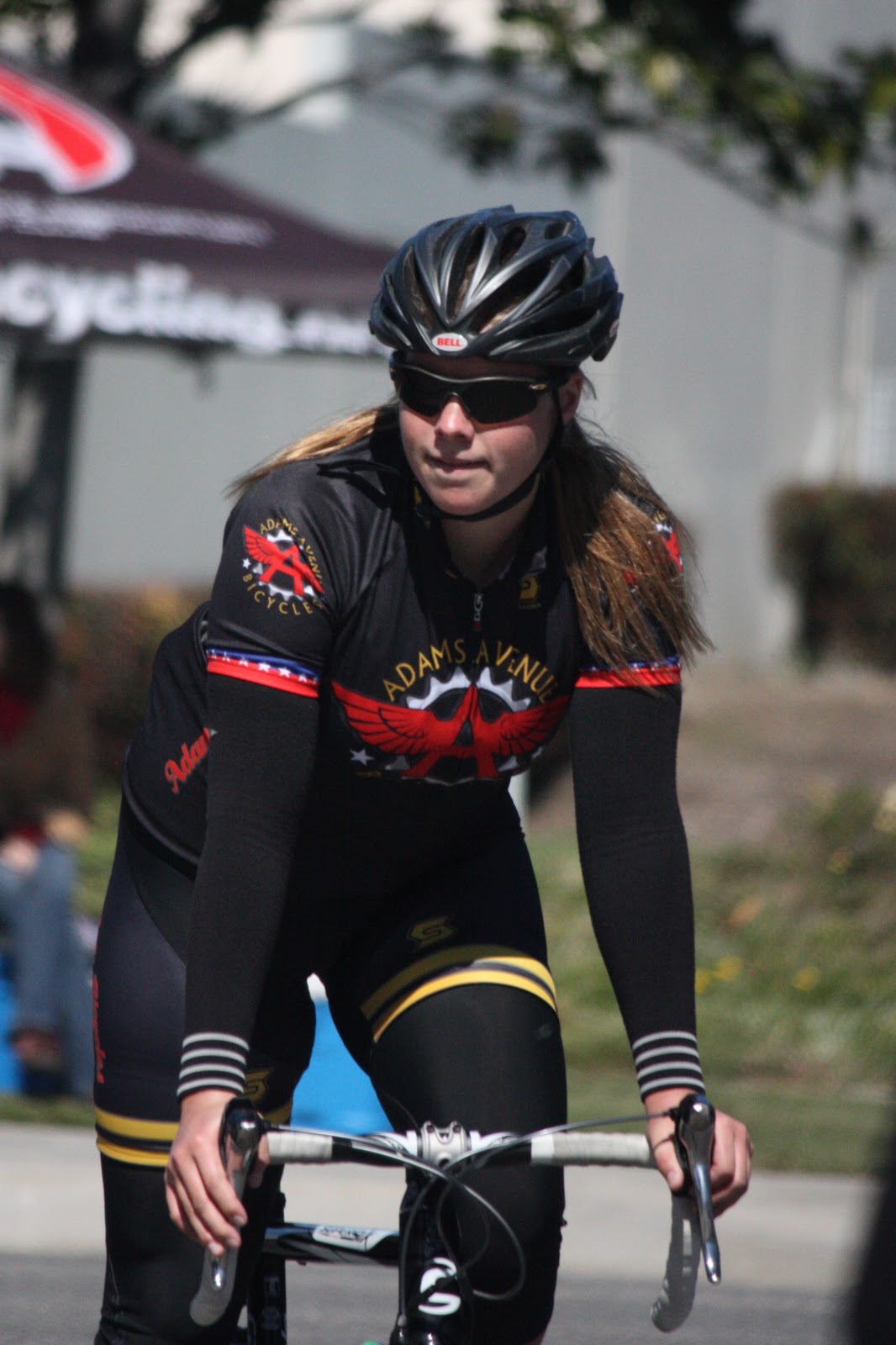
This young woman won the women's Pro/1/2 race; pretty good right? Then you watch as she does a roll-out for the official, and you realize she is still a junior. Now you're impressed.
Fun to go to races after some number of years and see people from long ago. Ray Moreno and I were both with the Chevy/Sheriff club in the early 90s.
Saturday, February 19, 2011
An afternoon at the Los Angeles Velodrome...
The son and I spent an enjoyable, rainy afternoon indoors at the LA Velodrome watching some of the racing during the first round of the LAVRA Cup. I have been to the Encino Velodrome a handful of times, but never to that tracks younger and more glamorous sister at the Home Depot Center. Indoor velodromes, like this one, lend themselves to some interesting photo opportunities, so while I took some still shots, the boy did some filming. The action was quite fierce, but unfortunately like so many local-oriented bike racing events, they just don't have the draw to bring out large numbers of spectators - it was most definitely worth an afternoon though. Oh, and photographs just do not do those banked turns justice. They are steep.
Los Angeles Velodrome, LAVRA Cup 2011, Round 1 from Michael Wagner on Vimeo.
If you really want to see something dramatic, check out the photo on Ride the Black Line, of the splinter that Malaysian racer Azizulhasni Awang picked up in his leg after crashing. Makes me queasy. To top it off, Mr. Awang remounted and finished third. That's some tuff stuff.
Labels:
LAVRA Cup,
Los Angeles Velodrome,
racing
Friday, February 18, 2011
Return of Alexi Grewal...
photo from Back In Among The Wheels
I don't know how many of you are aware of the attempted comeback of 51 year old Alexi Grewal. It has not been big news, though I have been following his blog, via his website Back In Among The Wheels, for a couple months now, and just this morning notice that Velonation has come out with a story. Being only three years my senior, our racing careers have run mostly parallel (though at very different levels) and as I strive to make my own comeback to competitive cycling, I will be following Alexi's progress with great interest. For those who may have forgotten, Mr. Grewal won Olympic gold in the Road Race during the 1984 Games held in Los Angeles, he also had a solid career riding for 7-11 in Europe and then for Coors Light in the United States. His climbing prowess allowed him to win the Bob Cook Memorial Mt. Evans Hillclimb on three occasions, and to take 1st overall in the 1982 edition of the Cascade Cycling Classic. Making a comeback to a sport in which you were once at the top is, I can imagine, easier said than done; whatever the outcome, though it should be fun, and hopefully inspirational. I wouldn't mind glancing to my left some day and seeing him lined up a couple riders away awaiting the sound of the gun.
August 2011 update: If you are reading this, you may have attempted to jump to Alexi's blog Back in Among the Wheels, and found that it no longer exists. I don't recall reading anything specific, but I suspect that as Mr. Grewal came to realize that coming back to a high level of competition, was not progressing as hoped, he pulled the plug, and returned to a life outside racing. If this is true, I think it unfortunate, he clearly possesses a wealth of history and experience, which I am sure would have made for some great stories.
December 2011 update: Here is the link to a VeloNews story about Alexi Grewal and his comeback attempt. It is a terrific interview in which Alexi explains the factors involved in undertaking a return to racing, the realities of the venture, and his reasons for calling it quits. Very candid, as you would expect from Mr. Grewal. I, like so many others, wish him the best.
Labels:
Alexi Grewal,
racing
Thursday, February 17, 2011
Scorcher and the Preacher, 1894...
I have always had a special interest in history, and in turn a fondness for historical references to cycling. Below is one such example that I found in an old publication called the Great Divide.
While bicycling is an especially egalitarian activity, the sport of cycling has long been troubled by unequal access to materials, equipment, technology and training methodology. Every so often someone in the media will point this out, or a rule will be passed by the UCI in an attempt to level the worldwide playing field. The type of blatant racism as depicted in this illustration is, I would like to hope, representative of a time in the past and confined to the historical record.
Saturday, November 27, 2010
Cycling 101A: Why not single-file...
One of the frequently uttered complaints about cyclists made by the non-cycling or even, infrequently cycling public, concerns the amount of space the peloton takes up on the road - you know, things like "why can't those damned cyclists ride in single-file, etc. These are largely the utterances of people who have been conditioned by their auto-dependence, where single-file procession is a fact of the activity. Sure you can change lanes, but really that is just moving from one line to another. The peloton operates under entirely different conditions. These conditions are influenced by 1. physical features in the environment, 2. the competitive nature of the activity, and 3. vagaries inherent in any large group of individuals.
Take relatively minor things in the physical environment - cracks, rocks, glass, nails and other debris - these are things too small to even be noticed by drivers, let alone be of concern, but can be serious obstacles to a rider, capable of knocking a bike off course at the least, and laying it flat at the worst. Obstacles such as these will require an avoidance action on the part of the rider, anything from briefly lifting the front wheel, to bunny-hopping the offending object, to swerving around it. When a rider is pedaling along solo, there is usually little problem; but when riding in a group the reaction is compounded. We are all somewhat familiar with the saying "for every action, there is an equal and opposite reaction"; you may have first heard this in high school science class. If one rider in the middle of the peloton moves left to avoid a pothole, for instance, the movement may put him into a space already occupied (which is of course another rule of science, that no two objects can occupy the same space at the same time) by another rider, thus forcing that rider to move left in turn. This action and reaction may be repeated any number of times until reaching the rider on the outside of the peloton.
The action of slowing will cause similar reactions and, if the slowing happens suddenly, riders especially those riding along the sides, will often move even further out, provided space to do so is available. Consider a barrel-type spring for a moment - a spring, when under load will be narrower at the center as it stretches out to hold the weight; remove the weight and the spring will contract, widening out at the center until it returns to its non-load bearing shape. The peloton operates much the same, though for a different reason. As the speed of the peloton increases the group tends to become stretched out. One of my few moments of glory came in a local road race when I accelerated fast enough and long enough to look back and see one long line stretched out in my wake. Of course that speed cannot be maintained indefinitely, and as the speed is removed (just as the weight of the spring) the peloton will bunch up and spread out at the middle.
"Sommers, hold your line" is perhaps the most oft quoted line from the most well-known cycling film, Breaking Away. Of course "line" in this case does not refer to an actual line persay, as if the race were proceeding along in nice ordered rows. No, what it refers to is following a predicable course and not making any sudden or unexpected moves necessitating a contrary reaction from other riders. I have often thought that, when viewed from above, the peloton must resemble a single living organism, such as an earthworm, that expands and contracts as it moves along. The problem is that this resemblance is one of appearance only. Since the peloton is composed of many individuals of differing abilities it cannot be expected to operate in an entirely predictable manner. On any given day, on any given group ride, the riders in the peloton will have a wide range of physical ability, practical experience, and what I term "comfort level". These vagaries and differences can have as much effect on the entire group as do physical features encountered along the route. Outsiders looking in will often wonder at how close the riders are to one another. Not infrequently this proximity results in harmless bumping, and yes, even crashing in the middle of the peloton. Newer riders, lacking in experience or the fortitude to ride in the middle of such a seething mass, will often ride to the sides of the group. This can be safer, but is also more difficult and tends to further spread out the group.
Cycling is a competitive activity, and most group training rides effectively simulate race conditions with riders doing what is necessary to succeed, within reason. During any training ride there will thus be occasions when the peloton becomes strung out in a long line due to increased speed, and there will be other times when the speed slows and riders bunch together to conserve energy. Single-file does not happen during a race, unless there is a team time trial taking place, or a smaller group of riders gets away from the larger group and forms a paceline to maximize their efforts. Expecting that a group of riders will follow one another in an orderly single-file line, and confining themselves to a narrow ribbon of asphalt along the margin of a road or street under these conditions is anything from optimistic to delusional, depending upon perspective.
Take relatively minor things in the physical environment - cracks, rocks, glass, nails and other debris - these are things too small to even be noticed by drivers, let alone be of concern, but can be serious obstacles to a rider, capable of knocking a bike off course at the least, and laying it flat at the worst. Obstacles such as these will require an avoidance action on the part of the rider, anything from briefly lifting the front wheel, to bunny-hopping the offending object, to swerving around it. When a rider is pedaling along solo, there is usually little problem; but when riding in a group the reaction is compounded. We are all somewhat familiar with the saying "for every action, there is an equal and opposite reaction"; you may have first heard this in high school science class. If one rider in the middle of the peloton moves left to avoid a pothole, for instance, the movement may put him into a space already occupied (which is of course another rule of science, that no two objects can occupy the same space at the same time) by another rider, thus forcing that rider to move left in turn. This action and reaction may be repeated any number of times until reaching the rider on the outside of the peloton.
The action of slowing will cause similar reactions and, if the slowing happens suddenly, riders especially those riding along the sides, will often move even further out, provided space to do so is available. Consider a barrel-type spring for a moment - a spring, when under load will be narrower at the center as it stretches out to hold the weight; remove the weight and the spring will contract, widening out at the center until it returns to its non-load bearing shape. The peloton operates much the same, though for a different reason. As the speed of the peloton increases the group tends to become stretched out. One of my few moments of glory came in a local road race when I accelerated fast enough and long enough to look back and see one long line stretched out in my wake. Of course that speed cannot be maintained indefinitely, and as the speed is removed (just as the weight of the spring) the peloton will bunch up and spread out at the middle.
"Sommers, hold your line" is perhaps the most oft quoted line from the most well-known cycling film, Breaking Away. Of course "line" in this case does not refer to an actual line persay, as if the race were proceeding along in nice ordered rows. No, what it refers to is following a predicable course and not making any sudden or unexpected moves necessitating a contrary reaction from other riders. I have often thought that, when viewed from above, the peloton must resemble a single living organism, such as an earthworm, that expands and contracts as it moves along. The problem is that this resemblance is one of appearance only. Since the peloton is composed of many individuals of differing abilities it cannot be expected to operate in an entirely predictable manner. On any given day, on any given group ride, the riders in the peloton will have a wide range of physical ability, practical experience, and what I term "comfort level". These vagaries and differences can have as much effect on the entire group as do physical features encountered along the route. Outsiders looking in will often wonder at how close the riders are to one another. Not infrequently this proximity results in harmless bumping, and yes, even crashing in the middle of the peloton. Newer riders, lacking in experience or the fortitude to ride in the middle of such a seething mass, will often ride to the sides of the group. This can be safer, but is also more difficult and tends to further spread out the group.
Cycling is a competitive activity, and most group training rides effectively simulate race conditions with riders doing what is necessary to succeed, within reason. During any training ride there will thus be occasions when the peloton becomes strung out in a long line due to increased speed, and there will be other times when the speed slows and riders bunch together to conserve energy. Single-file does not happen during a race, unless there is a team time trial taking place, or a smaller group of riders gets away from the larger group and forms a paceline to maximize their efforts. Expecting that a group of riders will follow one another in an orderly single-file line, and confining themselves to a narrow ribbon of asphalt along the margin of a road or street under these conditions is anything from optimistic to delusional, depending upon perspective.
Labels:
group riding,
racing,
training
Saturday, October 2, 2010
Krosstoberfest Day One...
The first day of Krosstoberfest was about as good a day as one could hope for, humid, muddy beards, cyclocross, racing, Focus, Specialized, Musseuw, durty women riding bikes, chicken tacos, and turkey dogs, miles and miles of yellow caution tape, still without a crossbike of my own. The racing was exciting. Did not stick around for the UCI pro men's race, but did see the UCI pro women, which was as high calibre as you would expect a race with UCI implications to be. Races take place tomorrow as well, and is just a quick ride from Claremont to Bonelli Park, north shore. You will have a great time, if you have a little time to spare. Just a few photos of the overly many I took are here, as usual though follow the link for a slide show of them all.
Labels:
Bonelli Park,
cyclocross,
Krosstoberfest 2010,
racing
Thursday, September 2, 2010
Sam Emerson racing photographs...
I just came across this Facebook page. Quite a nice collection of historic racing photographs taken by Sam Emerson. Most of the photos are black & white and dating to the 1980s. Races around Southern California mostly, but some beyond the border as well. When you have some time to give them a good look, it is well worth it. Some of the big names of the local racing scene are represented as well as some who went more than a bit further; here is just a tease:
Mark Rayner and Thurlow Rogers
Labels:
Mark Rayner,
photographs,
racing,
Sam Emerson,
Thurlow Rogers
Tuesday, August 24, 2010
From the archives...
Here is another photo from the 1993 Los Portales Whittier Grand Prix. If anyone knows who that is leading out, let me know please. The larger teams are represented up front - an L.A. Sheriff and two Saturn riders. But what I find more interesting are the prevalence of the Scott Drop-in bars. They were a classic example of something exploding onto the scene, enjoying widespread use for a handful of years, and then disappearing as quickly as it arrived. I am sure you can still find them at the bottom of parts bins in garages across the country; I, unfortunately have no recollection of where mine ended up.
Labels:
racing,
Scott drop-in bars,
Whittier Grand Prix
Friday, June 25, 2010
49th MBGP...
The 49th Manhattan Beach Grand Prix is this Sunday, June 27. This is one of the best spectator races in SoCal, always attracting a large enthusiastic crowd. It is also one of the most prestigious races, drawing the top regional and national teams, as well as the occasional international rider. Besides the pro and amateur races, there is an expo area, kids races, and the oval course is walking distance to the beach, and pubs and restaurants of downtown M.B. Great excuse to escape the inland heat. Unless there is a successful break, the races usually end in fast bunch sprints where you never know what will happen. And, needless to say, that is why you never saw me on the podium; though I did look forward to the race every year just for the thrill of racing in front of the large crowd.
The inevitable crash in the final turn, 1993 edition
Labels:
Manhattan Beach Grand Prix,
racing
Sunday, June 20, 2010
Monday, May 3, 2010
Here's to old riding buddies...
Last night, out of the blue, I received a phone call from an old cycling buddy from my racing days; someone I had not seen or even talked to in a number of years. It was totally cool, bringing back a peloton full of memories. I met Dave in the very early 1990s when we were doing the Bicycle Doctor ride on Saturday mornings. I had been racing with the Chevrolet/LA Sheriff club for a couple years, and he was looking to get back into the sport after a number of years away. Though I tried to recruit him, he was determined to rejoin the team he had raced for in the 1970s; it worked out well, as he became one of the premier local master's level racers.
We would occasionally drive to races together in the gawd-awful early hours of the morning, during which he would subject me to all sorts of Republican propaganda. There were times when we would skip out on the Tuesday/Thursday Rose Bowl training race after a few laps, and ride onto the Brookside Golf Course clubhouse patio, order some beers and toast the peloton as they would fly by each lap, and then go back to making fun of all the golfers. There were epic rides up into the local mountains, there was the bestowing of my first cycling nickname, bubba.
Beginning in 1998, when my son was born, I began to lose contact with the sport as family took up more and more time. By 2002 I let my racing license lapse, finally accepting the reality that any real opportunity of a serious comeback would be years away. That was when I lost contact with Dave as well. I know he continued to tear it up at races because I followed the scene through the racing media. But Christmas cards each year were about it until last night, and that is just not right when there were so many good times. So, I raise a cup o' joe this morning (can you guess who started my on that habit?) to old cycling buddies who shared laughs, epic rides, races, political banter, cycling library videos, unidentified cow bones, spare tubes, and what not; and let those good times continue to roll.
We would occasionally drive to races together in the gawd-awful early hours of the morning, during which he would subject me to all sorts of Republican propaganda. There were times when we would skip out on the Tuesday/Thursday Rose Bowl training race after a few laps, and ride onto the Brookside Golf Course clubhouse patio, order some beers and toast the peloton as they would fly by each lap, and then go back to making fun of all the golfers. There were epic rides up into the local mountains, there was the bestowing of my first cycling nickname, bubba.
Beginning in 1998, when my son was born, I began to lose contact with the sport as family took up more and more time. By 2002 I let my racing license lapse, finally accepting the reality that any real opportunity of a serious comeback would be years away. That was when I lost contact with Dave as well. I know he continued to tear it up at races because I followed the scene through the racing media. But Christmas cards each year were about it until last night, and that is just not right when there were so many good times. So, I raise a cup o' joe this morning (can you guess who started my on that habit?) to old cycling buddies who shared laughs, epic rides, races, political banter, cycling library videos, unidentified cow bones, spare tubes, and what not; and let those good times continue to roll.
myself (left) with SuperDave at start of the Gunlock Road Race, stage 1,
Chums Classic Tour of St. George, c.1995
Sunday, March 21, 2010
San Dimas Stage Race 2010...
Winner of the Cat 3 race
45+ g.c. jersey winners
45+ crit champions
Amgen elite masters team train charging to the line in the 35+ race; and yes that is exactly the reason those two have extra stripes on their jersey sleeves. Chris DeMarchi with the national champion stars and stripes, and Thurlow Rogers with the World's Champion rainbow stripes.
Thursday, March 4, 2010
From the archives...
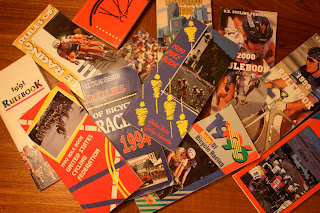
There was a time when the (USCF) United States Cycling Federation (now USA Cycling) would send these rule books out to all new and renewed licensees. I received my first in 1989, and have booklets through 2001. Since we received a new one every year, I am not sure why I kept the old ones, but I did and there they are. They are full of information including bylaws, rules of racing, lists of prohibited substances, lists of past and current national champions, and licensee demographic charts. The same information is now available on the USA Cycling website, but as a one-time librarian I prefer to hold a book in my hands. It is interesting to compare the demographics year-by-year. For instance in 1989 there were 29,214 licenced men and 2,555 licenced women, of all ages. In 2009 there were 44931 men and 6520 women racers. That is a considerable increase, but honestly, after the passing of twenty years I would expect to see an even greater increase, and wonder if even more emphasis should be given to the growth of the sport.
Labels:
racing,
USA Cycling,
USCF
Monday, March 1, 2010
A setback...
Well, the first two races I had targeted to start the season with have passed without me. Not necessarily a bad thing, I guess. Between rain and house-hunting, I have not exactly had enough training time lately, so really I would have been so much fodder in the field.
Labels:
racing
Subscribe to:
Posts (Atom)